


Ever had the experience that you can sense emotions on the outside of your self? Or that when letting your hands come close together, slowly, it feels like there’s a field between them? Or that there’s shells of different fields that continues all the way out through your “personal space”? Or that different body parts feel bigger or smaller depending on the attention you give them, or your emotional state? Or that there’s a buzz of activity in your body, that can move out of your heart or above your head?
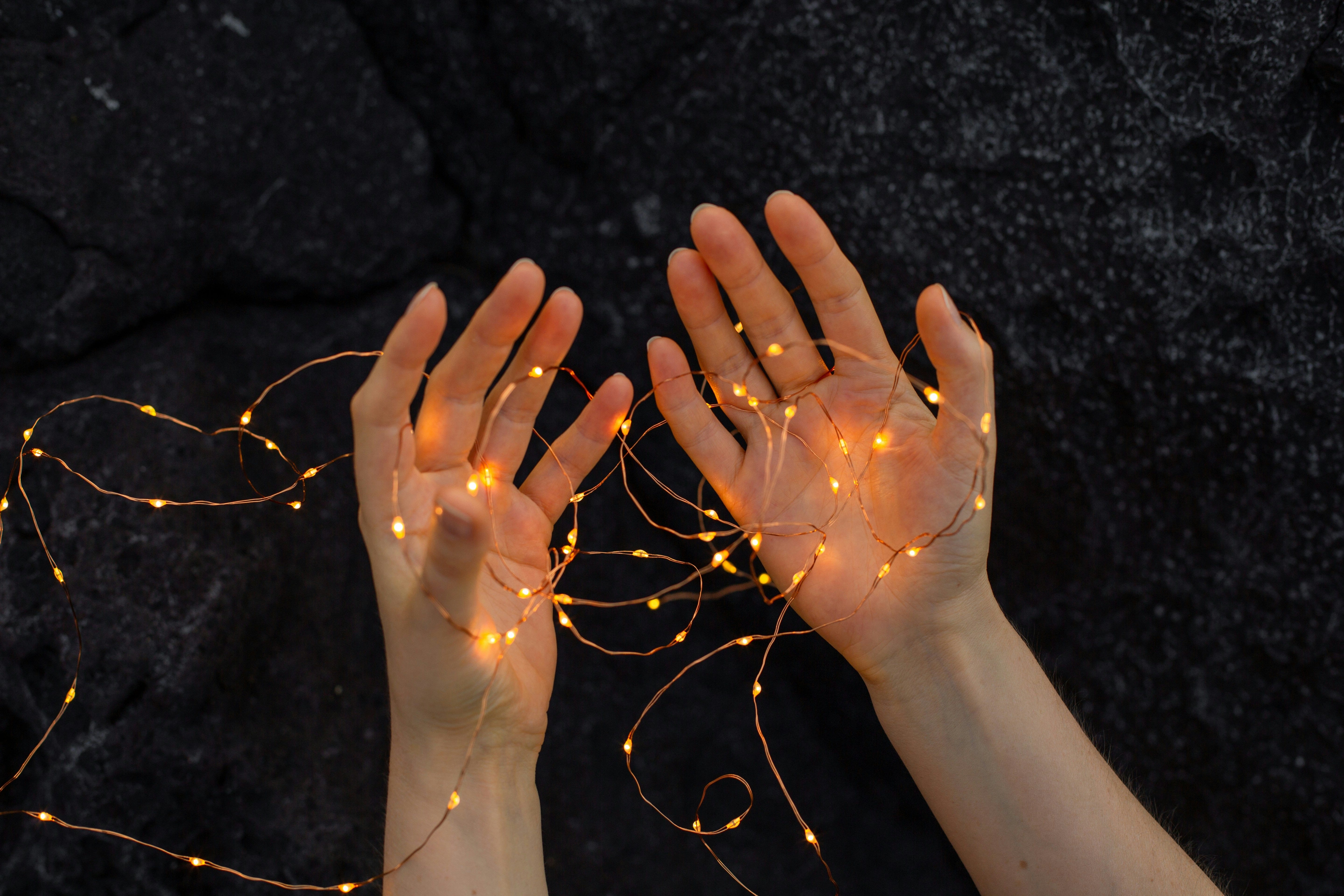
I’m gathering concepts to build up a hypothesis: Our experience of an energy field and energy moving in the body is a product of the way the brain maps your body.
This does not mean that you can sense supernatural things within your energy field. It also does not mean that you can’t. I find it interesting, but the contempoary research on the subject is tricky methodologically, underfinanced and too contested to bring forth a — to me at least — compelling argument. I hold the idea lightly and hope to see more research and openness around it in my lifetime. But this article will not be about supernatural phenomena, but about how we can map out the space adjacent to the boundary between supernatural and conventional.
My reason to put this hypothesis together is to explain the experience of something that is not within your body. Because this is a very common experience, many people will say yes to one or more of the questions in the beginning. Also, the phenomena of phantom limb sensation (e.g. when an amputated arm is itchy) is well-researched and will be part of my argument. And why is this interesting? I find it interesting because it’s on the edge of the map - the new-age spirituals rejoice in “the reality of the energy field” and the rationalists in the “it’s just in your head”. But I find that both miss out on something important: “the reality of the energy field” do not contradict “it’s just in your head”.
All experiences are real
All experiences arise from some kind of brain activity (or the lack of it)
This statement is of course contested, but I like the argument put forth by neuroscientist, Andrew Newberg:
“If you were to dismiss spiritual experience [like unity consciousness or blissful states] as ‘mere’ neurological activities…you would also have to distrust all of your own brain’s perceptions of the material world. But if we do trust our perceptions of the physical world, we have no rational reason to declare that spiritual experience is a fiction that is ‘only’ in the mind.
It does of course not automatically follow from “all experiences are real” that hallucinations are shared in a morphic field or similar catchy Deepak woo-vibes. Neither can we at all logically deduce that what we experience is the only thing that exist. It also does not mean that your meaning-making around your very valid experience is analytically valid. It just means that if you experience something, your subjective sensory input or interoception did happen (and possibly sparked some meaning-making). And there inside your skull is a physical-electrical correlate to your experience.
Ok, ok, enough caveats.
How come our brain produces experiences of energy fields outside our body?
To get into that question from the technical side, let’s start by explaining how the brain generally creates the experience of your body:
There is a map of your body in your brain.
It’s a 2ish cm broad strip running from approximately behind the upper tip of your ear, over your head, to the other ear. This strip contains — within the network of tens of millions of neurons — a spatial map of your entire body called the somatosensory cortex. This map isn’t proportional to physical size: areas with high sensitivity (like your lips and fingertips) take up much more neural attention than less sensitive areas (like your back).
The somatosensory cortex handles many sensory tasks, including:
Detecting touch, pressure, pain, and temperature
Identifying objects through touch
Knowing where your limbs are in space (proprioception)
Storing sensory memories (e.g., the feel of velvet)1
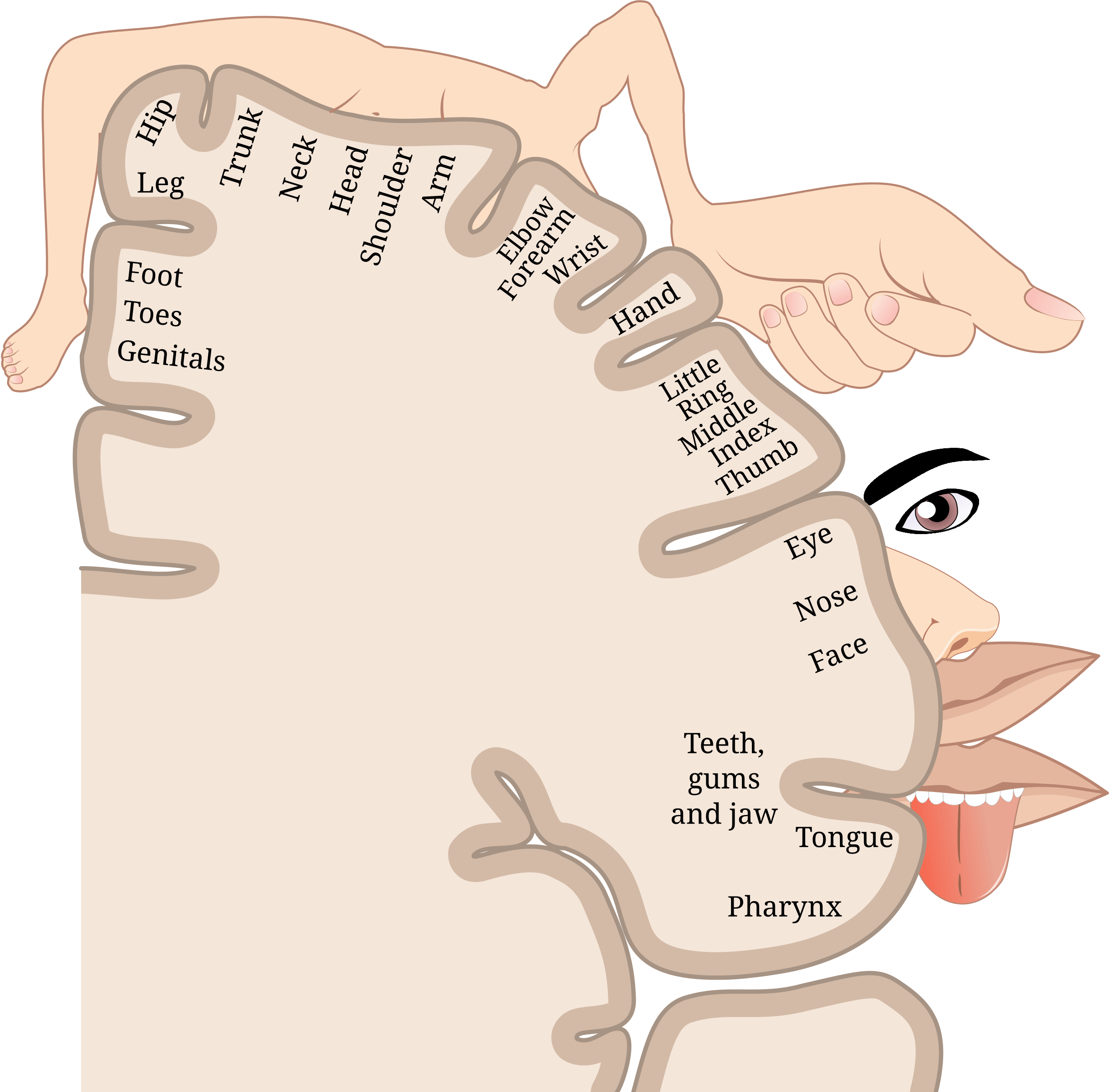

As most other things in your brain, this map is not fixed. In a famous example, neuroscientist V.S. Ramachandran studied people with amputated arms who felt vivid sensations in their missing hand when their face was touched. Brain scans revealed that the face region sits next to the hand region, and after amputation, the face area “invaded” the now-unused hand territory. The brain had literally redrawn its own map, optimizing its neural resources.
Importantly, this map is BOTH a representation of your physical body AND a creator of your experience of your body. If you prick your finger, there is activity in the finger-area of the map. And if you stimulate the area through transcranial magnetic stimulation, your will feel like your finger is tingling.
Additionally, your brain also have a representation of your surroundings:
The multi-modal integration of your personal space:
Gathering information from eyes, ears, touch, and proprioception, the brain creates the peripersonal space. Different from the body-map that is quite stable, this representation is moment-to-moment dynamic and includes:
Your body parts: mostly fingers, arms & legs, but also other parts when relevant
Objects in your immediate vicinity (40-70 cm) or object coming closer to you
Objects you use as tools: A bat, rake, pen etc.
The neuron can use several sources of information: In one of the two main areas, the Ventral Intraparietal Area, a neuron might fire when your hand is touched or when a visual object approaches your hand, but not when that visual object is far away. Similarly, in the Ventral Premotor Cortex neurons gather multisensory data and creates readiness for defensive movements or coordinated reaching-gestures.
Additionally, “body-matching neurons” in the Ventral Intraparietal Area respond both when a visual object approaches a specific part of the participant’s own body AND when an object approaches the same body part of another person being observed.
Relevant for the energy-field experience, the coordination of movements within the peripersonal space is body-part-centered, and not eye-centered or external-world-centered. Additionally, it is socio-emotionally modulated: Anxiety and also other people’s presence affect the size of our peripersonal space — when close to someone, this measurably limits our own space in a dynamic fashion:
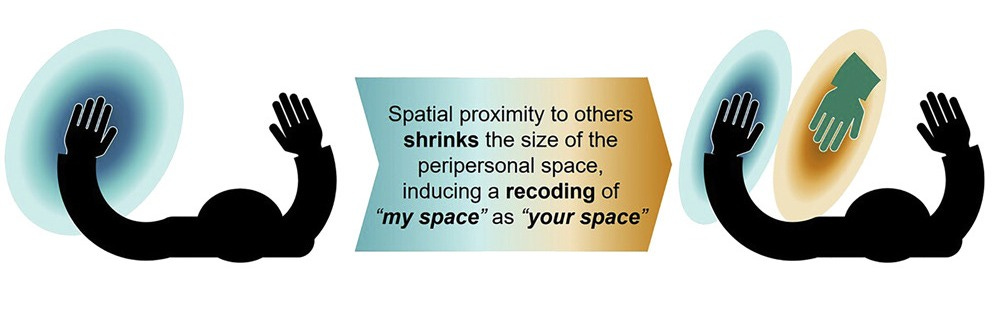
I did not find many direct experiments on this, but I expect this dynamic size change and body-part-centering is informing the interoceptive networks that creates the “inner experiences”, and therefore to some degree allows any objects within the peripersonal space to merge with or influence the experience of what is “ours”. There might be an a way where this is an underlying neurological basis for the experience of “other people’s energy field is affecting me”.
One experiment that seem to confirm this, is that when facing another person (versus a mannequin), participants’ peripersonal boundaries shrank—suggesting a defensive response to social presence. However, after playing a game together, peripersonal boundaries between self and other merged, but only when the partner had behaved cooperatively.
Another experiment continued the collaboration exploration: “[T]his increase [in integrating sensory input] did not extend across the space between participant and confederate, as would be expected if the participant׳s PPS had expanded. Thus, the pattern of results is more consistent with a partial remapping of the confederate׳s PPS onto the participant׳s own PPS.” This inspired yet another similar experiment which showed that “the human brain has some mechanisms for connecting the PPS and/or body of others with one’s own” and that “[the mirror] system is more strongly activated by observing human actions than by observing non-biological movements”.2 Yet, as I mentioned, none of these experiment measured the direct brain activity during the experiments, the peripersonal space is deduced from behaviour (so, future neuroscientists, you now know what to study).
The integration of the information
All these different networks collaborate and integrate the information/representation in our subconscious. We anticipate tactile events before they occur, combine this with information on where our body parts are (proprioception) with where objects are (vision/audition) and prepare for action so we can respond appropriate to the approaching stimulus. This response can be a bodily movement, but also the creation of thoughts or new emotions.
Researchers has recently found a new network, they named Somato-Cognitive Action Network (SCAN), that seems to execute plans of moving the body. It integrates mind and body by linking to other brain regions controlling breathing heart rate, muscle tension, even butterflies in the stomach, all of which provide feedback for planning future actions. This network also to regions important for drive and motivation. Interestingly, the precursor network we are born with is trained during your first year from experiencing your body and getting sensory feedback and rather functional by age 1 year.
Ok, here we go - energy field hypothesis:
We now know that:
The felt sense of your body depends on a body map in the brain. You can have sensations in a limb without anything happening out there in your limb.
The boundaries between the body part representations can in some cases be a little… fuzzy.
There exist a dynamic representation of the immediate space around you and any tools you use.
Emotions are affecting the representation of the space around you.3
The integration of this information arises in a time of life where we have limited conceptual awareness and mostly navigate without language.
And now follow me:
The brain doesn’t care about “reality”, it just tries to predict the incoming stimuli and keep you alive. And it responds to its predictions with movement or emotions. So if it’s efficient for survival to not only represent the limbs within the brain, but also our collective physical-social-emotional surroundings.
Constructing a concept called “energy field” based on observing our internal sensations is an easy cognitive move, done by countless cultures. Naming emotions (body-states and perceptions) makes them clear and accessible for one self and contributes to pro-social behaviour when shared.
So energy fields are very real, in the same manner that emotions, cultural memes, language are real. They are not necessarily true. Not necessarily placed physically where we experience them4, but still very real.
Possible implications of the reality of an energy field
I’d like to play a little with the hypothesis and the wordings related to it, and see how far we can stretch it. Notice where your own ontology says “no”. Also notice if there’s a discrepancy between what you kinda think is true, and what you socially would admit believing in. Is there some shame related to a contrast between your lived reality and what is socially accepted?
Here we go:
“Energy flows when our heart opens.”
Emotions express themselves in the experienced interpersonal field between us, when we feel “connection”.
“I can practice charging my energy field.”
Focused attention changes the energy field.
“I can feel your energies vibrating towards me.”
We can pick up subtle cues from others, subconsciously express our reactions and this creates ripples and interference in the interpersonal field.5
“I can stay in my own field even when people are upset.”
Holding space for someone includes allowing their energy field — subtle cues transformed into emotional valence — to be co-regulated by your nervous system. You might not be afraid, so their fear is not mirrored back but dissolved or “held”.
“I can feel how charged the room is.”
The energy we sense in a room upon entering is the aggregate of multiple nervous systems co-regulating and broadcasting their predictions about each other, and is experienced as a unified field quality rather than a person-by-person assessment.
“I notice when someone pointing their energy towards me.”
When we feel watched, it gets represented as sensations in our neck, because it’s the most vulnerable area, and therefore an evolutionary effective way of surviving.
“I can feel the vibrations of the history of this place.”
The energy attributed to places (graveyards, childhood homes etc.) might be the brain pre-loading emotional-somatic predictions based on memory, cultural priming, and architectural cues — the field exists as the place evokes a particular body-state that is experienced in the energy field.
“I can feel the whole group raising the energy”
Group flow states could be moments when individual peripersonal boundaries temporarily blur into a genuinely shared predictive space.
I’m on purpose not putting clearly supernatural experiences in here, as I promised to stay on the part of the map that is adjacent to the boundary between supernatural and conventional. But are there still any of these implications or just wordings that ick you? Or do you miss to explore the boundaries closer? Wanna jump into the deep waters of yet-to-be-accepted experiences and explanations?
It’s a joy for me to research and write these articles, so if you have other themes you’d like me to explore or experiments or theories that contradicts my hypothesis, please contribute to our shared space in the comments!
Party trick: I dare you to close your eyes and imagine a newly cut stump. Now imagine how it would be to put your tongue to it. That’s a very vivid experience, huh? ;-) Imagination is also a very real experience, and possibly all of our experience according to Predictive Coding
The core idea of predictive coding, is that the brain acts as a prediction machine: It’s not just passively receiving sensory input and building up a picture of the world bottom-up, but constantly generates top-down predictions about what sensory input it expects to receive. Perception in this rather well-supported hypothesis is essentially the brain’s “best guess” about what’s causing its sensory signals, and not the light, sound, touch & temperature available. A similar process happens in the meaning-making of inner perception and thinking, the origin of emotions.
This section has been updated with extended quotes since initial publication.
And the space inside of you. There’s obviously plenty of internal cues from your interoception and body-map connected to memory and emotional states. But the cells of your non-brain body does not physically “store” memories or trauma.
When you do the calculation of 17+29 “in your head”, are the calculating happening in your head or in front of your head? Take a moment to observe it. Many people visualize the calculation where they usually would be able to “see” it — the representational space in front of the eyes.
A little AI summary of an neurobiologically plausible model of how others’ “energy” becomes “ours”, based on the articles I have read:
Step 1: Shared Spatial Representation
When you interact with another person, body-matching neurons in VIP encode space around their body parts using the same neural populations that encode space around your body parts.
Step 2: Vicarious Somatosensory Activation
Observing their posture, movements, and any touch they experience activates your own somatosensory cortex in a body-part-specific manner.
Step 3: Interoceptive Contextualization
Your insula integrates these vicarious body signals with your own interoceptive state (heart rate, breathing, gut feelings). If your interoceptive state signals safety and affiliation, this facilitates PPS expansion; if it signals threat, PPS contracts.
Step 4: PPS Merger or Boundary Dissolution
With positive social interaction, your PPS boundaries extend to encompass the other person’s near space. Objects or events near them now register within your body-protective zone and affect your tactile sensitivity and attention.
Step 5: Subjective Experience of “Their Energy”
Because PPS is experienced as part of the bodily self (not abstract external space), and because objects within it generate heightened arousal and faster responses, you experience events in the shared/merged PPS as directly affecting you—it feels like their presence, emotion, or “energy” is acting on your body.
Step 6: Physiological Entrainment
During sustained interaction, autonomic nervous system activity (heart rate, breathing patterns) can synchronize between people, providing bottom-up interoceptive signals that reinforce the felt sense of connection or being affected by the other.
I would like to comment that our energy field is likely not located in the brain as much as in the larger neuraxis. The distinction is very important for theories of embodied cognition and for contemplative sensory awareness.