“The amount of positive evidence came as a surprise to us (...) we would be ready to accept that homoeopathy can be efficacious, if only the mechanism of action were more plausible.”
“Where there’s smoke, there’s fire”, I said when I as a chemistry student in my early 20’ies wanted to defend my interest in homeopathy. I was not brought up with the use of alternative medicine. I’m a fully vaccinated kid from the 90’ies and the most progressive bit of my childhood was that we ate vegetarian in our house. Not because of the environment, but because my father was very spiritual. Superstitious, actually. If he was alive today and had tagged along on social media, he’d be part of a weird right-wing conspirituality corner.
My mom was (luckily for me) rather sane, and I ended up somewhat tempered in these manners. I carry a deep curiosity to subjects that mainstream society dismisses, but also a rigorous, scientifically trained mind. Somewhere in my coming of age, I decided to study chemistry inspired by my fathers keen interest thereof. But through those years I was also deeply discouraged by what I perceived as a lack of spiritual depth. My boyfriend at the time called himself a “militant atheist”. I ran away with a girl who studied anthropology.
I developed a fascination for the interface between mind and matter. I read research on psi, cold fusion, acupuncture and the anomalies of water. It bothered me that the samples sizes was small and the repetitions of the experiments few. I also read about CIA conspiracies, vaccines that caused autism and sunken Lemuria. It struck me as if these stories had a grain of truth, but was twisted into something so full of mistrust, neuroticism, and polarization that the truth was almost unrecognizable. I wanted to sort it all out and bring some truth and clarity to the table. In hindsight, maybe I desired this truth, so it could protect the “spiritual” part of me from the threat of “atheist rationality”… so all of me could feel safe (quite a connection to my other essay about listening to all parts!).
“It’s just water”
One evening during the first year of my master, I Googled “crystallization homeopathy”. I had come across homeopathy through the subject of water memory. At that point the popular movement was carried by the now very debunked Masaru Emoto’s pictures of ice crystals. These ice crystals showed different patterns by either kind thoughts (harmonious patterns) or negative thoughts (chaotic patterns). It was easy for me, as a trained chemist, to see his methods were worthless for what he tried to prove. But the thought of catching thoughts through matter was too appealing for me to let go. So knowing that homeopathy according to mainstream science “was just water”—but apparently water that showed consistent treatment effects on humans—I hoped that maybe someone with a bit more rigorous methodology had tried crystalizing it.
And my dreams came true(!) First hit on Google showed me that 100 km from where I lived, a über-rigorous, endearing elderly man had a laboratory where he through crystallisation methods studied how homeopathic potencies differentiate from water.
…or is it?
A little interlude to get you all onboard on homeopathy:
Homeopathy was developed in 1796 by German physician Samuel Hahnemann, who sought gentler alternatives to harsh medical practices of his era (for your reference: hand-washing was “invented” about 50 years later). Homeopathic remedies are crafted through a meticulous process of serial dilution and succussion (vigorous shaking). Each time the liquid is diluted 1:10 or 1:100. Very quickly there’s nothing left of the original substance: This happens around the 23rd time you dilute it 1:10.
Starting from plant, mineral, or animal substances, manufacturers follow standardized protocols to create these preparations. For ease of use these solutions are often dripped onto small sugar pills. Worldwide, over 200 million people use homeopathy on a regular basis, and it’s included in the national health systems of a number of countries e.g. Brazil, Chile, India, Mexico, Pakistan, Switzerland.
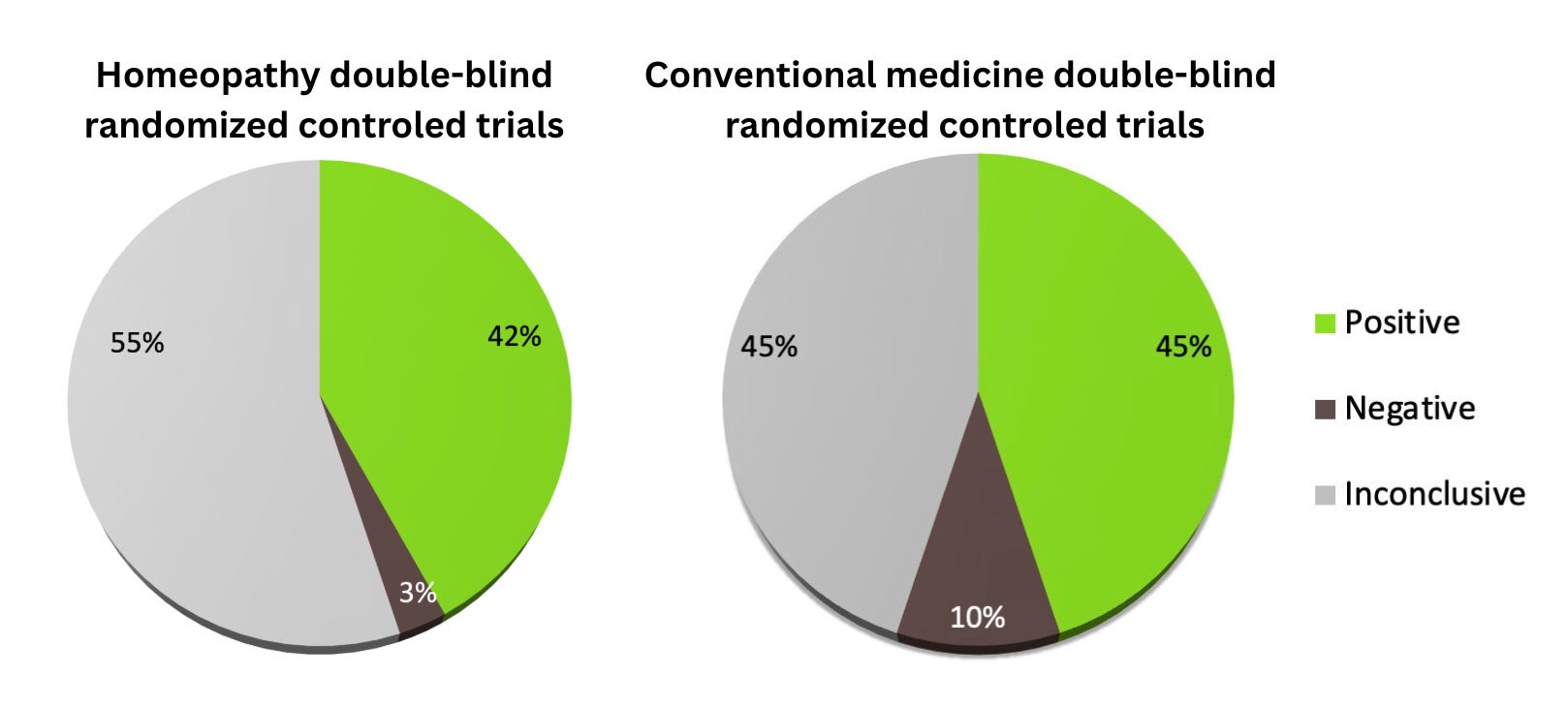
The principle concerning which remedy to prescribe is “like cures like”. A remedy given to healthy volunteers will give light symptoms (e.g. a hint of running nose, slight fever and weird dreams). The same remedy will then cure a person with those symptoms full blown (e.g. a flu). Lists of these “symptom pictures” are available for look-up online nowadays. The treatment effect of homeopathy is well researched, and positive:
A 2014 meta-analysis of placebo-controlled double-blind randomised controlled trials found that homeopathic medicines, when prescribed during individualised treatment, are 1.5- to 2.0-times more likely to have a beneficial effect than placebo.1
So there I was, carried by a stubborn science-attitude, stumbling into a world of serious scientists researching one of the most provocative alternative medicines:
Because nobody fucking knows why it works.
An this is why it’s so interesting. We got this phenomenon, this weird-ass effect where there should be no effect whatsoever.
On top of that, it is also a cost-effective healthcare system, and that brings about some trouble. In Denmark, where I live we have quite a costly health care system (cheap compared to US, though). It’s also effective’ish2. All treatments have to be “evidence-based” and judged by a committee if it’s worth implementing. But when it comes to homeopathy, even though the “real-life evidence” points towards implementing it as fast as possible to save our taxes, this is not happening because we can’t cope with not knowing why it works.
We know why monoclonal antibodies can treat breast cancer. Biochemists can explain how this fancy medicine on a molecular basis delivers toxic chemotherapy only to the cancerous cells. We designed those molecules to do what they do.
But when we treat patients with homeopathy, we are treating them diluted water on sugar pills. In all the double blind studies, this is compared to… other sugar pills. It’s not placebo, so what is it?
Nanoparticles, they say.
We (a subset of humans, interested in this subject) looked under the microscope. Like, one of those microscopes that can see nanoparticles. We found nanoparticles. Left-over nanoparticles from the dilution process stuck on the side of the flask or leached from the glass. But this minuscule amount of nanoparticles should not have any biological effect. You inhale 1000-fold of random nanoparticles every second.
A few nanoparticles of belladonna (deadly nightshade, a common homeopathic remedy), why would it do anything for your fever? You need a gram of paracetamol (Tylenol / Panodil) to take your fever down. That is in the range ~100’000’000 times more mass than a nanoparticle. Also, not all of the homeopathic remedies had nanoparticles.3 So how on earth could it be effective?
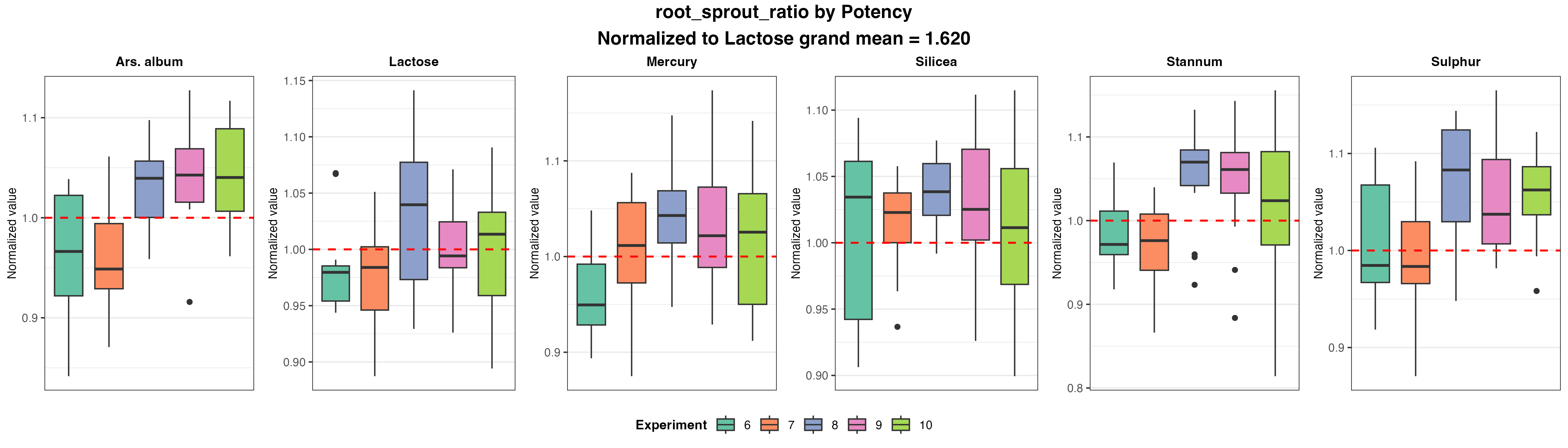
And that mystery, that’s why I, 22 summers old, hitch-hiked down to a small lab and explored how I could get into homeopathic research. I met open arms and got an internship, went back to the university that didn’t want to touch that with a ten-foot pole, waited it out, started a Ph.D., detoured into relational stuff, and now I’m back, sweating over R, two-way ANOVAs, and post hoc testing. And making these kind of graphs:
Phew! Just getting started. But I’m looking forward to letting you in on more of these curiosities. There are plenty. If you have some questions about this subject, it might become a new post - so PM me or comment below!