


One person’s healing is relevant data
The clinical N-of-1 trial is a rather under-valued concept, yet intuitively accessible: You’ve got a person who’s suffering. Then spend some time measuring how they are suffering, make an intervention, keep measuring, stop intervening, and continue measuring. There are variations: Blind the intervention and/or do successive periods with and without intervention (cross-over design). And then you look at the data, did the intervention make a difference?

At home we do this in a low-key way: If I cut caffeine after 2 pm, do I sleep better? If I stop scrolling, do I feel better? It’s easy to argue that these kinds of experiments are “unscientific”: They lack control groups, they suffer from recall bias, they are seldom blinded. But they are actually data. We navigate our lifes through casual action research — we poke, see how the system reacts, reflect, and decide our next action from there.
When done in the academic fashion, N-of-1 trials create data that is more “measured”. If you actually write down how well you slept or how good you feel before, during, and after the experiment, you can do a little stats on them: “did your sleep get significantly better?”. N-of-1 trials are often dismissed as merely a way to find the right treatment for one patient with a complex illness, because the results don’t readily generalise. “Just because you sleep better when cutting caffeine, does not mean that I do” is the argument. But I’d argue that N-of-1 trials has much more potential: We can make some qualified guesses on what is worth researching next. If you have 10 N-of-1 trials showing that drinking gellified chia seeds makes menstrual pain go away, isn’t that a pretty good place to start researching further?
Of course there’s a lot of placebo effect going on. It’s hard to blind chia seed drinking. But luckily we have methods to approach that: You can have different doses (1 glass per day, 2 glasses per day…) or active placebo (husk fibers, smoothies, etc.).
So at end of the day, we are making data, no matter how we twist and turn it. And when we make more data, we have more arguments for doing randomised controlled trials (the gold standard of evidence).
But what if one-size treatment does not fit all?
Why do people get menstrual pain (dysmenorrhea)?
Ok, I’m going to be a bit political here. I’ll start with citing Wikipedia:
There are two types of dysmenorrhea, primary and secondary, based on the absence or presence of an underlying cause. Primary dysmenorrhea occurs without an associated underlying condition, while secondary dysmenorrhea has a specific underlying cause, typically a condition that affects the uterus or other reproductive organs.
Painful menstrual cramps can result from an excess of prostaglandins released from the uterus.
So, you are telling me that we are diagnosing primary dysmenorrhea when we just don’t know why you have pain? Yes. And in the next sentence, you tell me that we do know what causes it, excess of prostaglandins? Yes.
I’ll stay in the anger and cite a .gov website:
Most teens with dysmenorrhea do not have a serious disease, even though the cramps can be severe.
Yes, severe pain is not a serious disease.
And this big Dutch cohort study shows how people still show up at work/school while reporting high pain intensity scores — and consequently report that they are less productive (presenteeism):
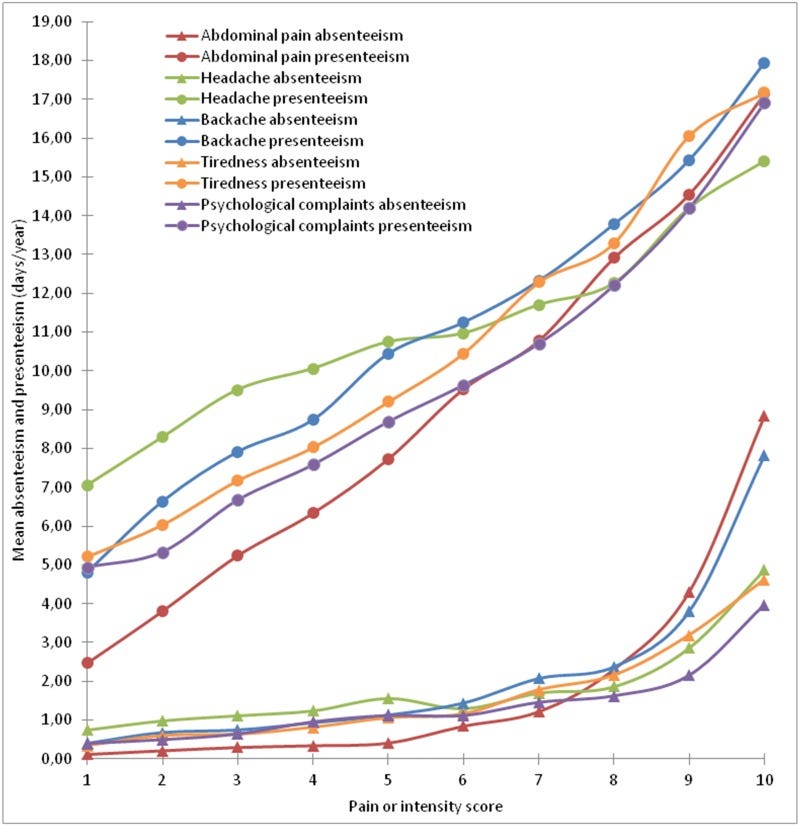
In that cohort, menstruation-related symptoms accounted for up to 24% of total absenteeism for women who were working or studying. And, the annual productivity loss due to presenteeism was sevenfold more than the annual productivity loss due to absenteeism. If capitalism worked as advertised, wouldn’t we have a better solution by now?
Ok, rant over. Back to the question: Why this pain, why no cure?
~70% of people with a uterus1 experience menstrual pain, and 2-29% of these to a degree that it inhibits them in their daily activities (depending on the definition of inhibition). As hinted above, it’s only slowly dawning on science over the last few years that it’s worth looking into this issue. But we have not yet found a cure. True, you can pop NSAIDs or use birth control, but both have quite a few downsides. And none of them solves the underlying problem: Excess of prostaglandins.
(Prostaglandins are btw hormone-like fatty molecules found in all kinds of tissues. They give you fever. And prevent your digestive system from self-digesting. And contract uteruses. You are complex, my dear, also on the biochemical level.)
One thing that does seem to solve primary dysmenorrhea, (PD, the non-endometriosis menstrual pain) is age. It typically eases through the 20s and 30s. However, longitudinal studies show this is mostly driven by childbirth. Each live birth reduces the odds of reporting PD by 80% (!!!); each year of age on its own reduces the odds by 8%.
But… kids are a very expensive treatment for PD. So back to research — we do know a bunch of risk factors for menstrual pain, let’s take a look:
Before conception: Family history is the single strongest predictor — having a mother or sister with menstrual pain raises odds 2–4× (and roughly half of this is heritable; the rest is shared environment + the sneaky bias where having an affected relative makes a woman more likely to get diagnosed and therefore included in a study).
While your mother was carrying you: Maternal smoking, exposure to endocrine-disrupting chemicals, stress and undernourishment are risk factors. They are related to giving birth preterm and/or with a low birth weight, which in turn is a risk factor for menstrual issues. But as you might sense, it’s not a clear-cut picture.
In childhood: Age at first menstruation matters, each year earlier raises the risk of menstrual pain. Childhood overweight is one of the strongest modifiable-ish factors. Body fat releases a hormone called leptin, which tells the hypothalamus there's enough energy stored to start the whole reproductive cascade a.k.a. puberty. Additionally, chronic stress, neglect, or abuse play a role in developing PD; chronic activation of the brain-hormone glands system (HPA-axis) (that runs the stress response and cortisol levels) seems to tune how the body processes pain and inflammation as an adult.
In adolescence and adulthood: Short menstrual cycles (under 27 days) mean more periods per year — and therefore more episodes of pain over a lifetime. Short cycles themselves are on average slightly more painful, likely because the same biology that shortens the cycle also amplifies the pain. Being underweight also raises risk, in addition to the classics: smoking, high caffeine intake, poor sleep, and ongoing high stress. History of sexual abuse appears repeatedly in the literature as a risk factor too — plausibly through the same route as childhood adversity. But all of the lifestyle causes are also affected by social class and childhood adversity, so it’s hard to say which came first.
…so somewhere in this whole accumulated mess, we’re looking for what causes the excess prostaglandins. I don’t know if you need a degree in medicine to conclude that possibly, a cure has to be individualised (if cures for everyone afflicted exist at all).
And that’s where I wanna get back to the stats & N-of-1 trials.
Lies, damned lies, and statistics
I’m gonna explain to you why it is that there are so many treatments that seem to “statistically significantly” work, and why so many women still are popping painkillers. I even made some graphs for you!
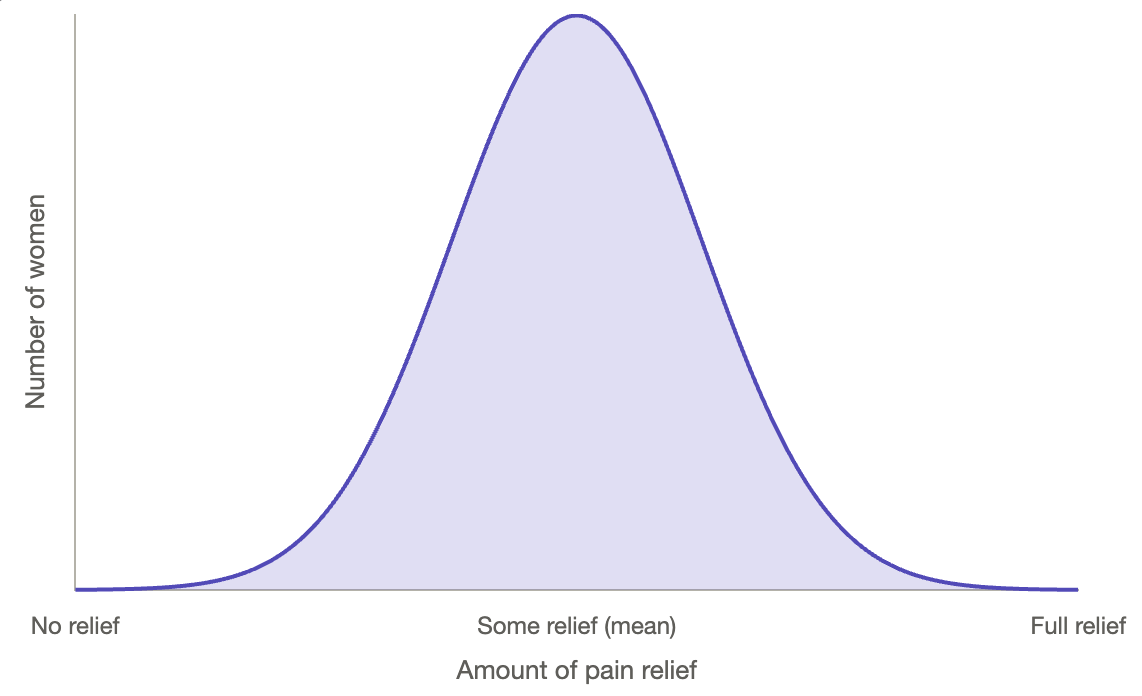
Let’s say that you are testing Magic Relief® on women with strong PD, and you find this curve:
And then you are testing Wonder Relief® and you find this curve:
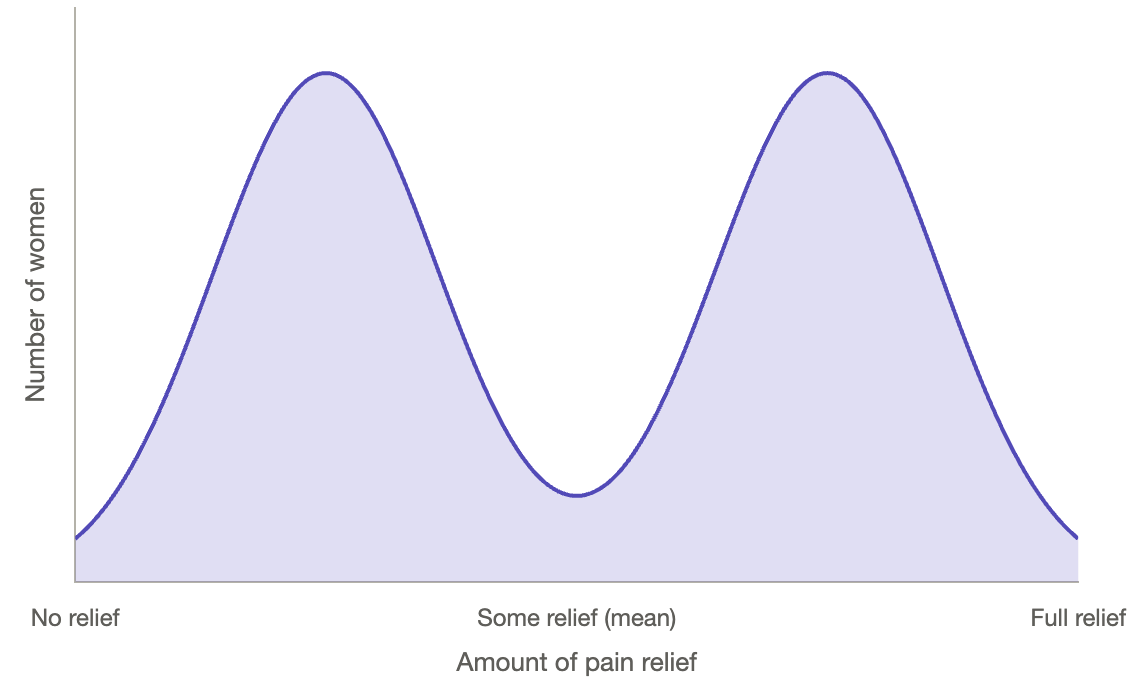
In your paper you can write “Both Magic Relief® and Wonder Relief® had a mean effect of Some Relief, and because we tested a big enough group, we can see that the effect is statistically significant (p < 0.05).”
Which remedy would you try first? The normally distributed curve of Magic Relief® shows that there’s a spread: Some respond well, some don’t, most somewhere in the middle. The bimodal curve of Wonder Relief® shows that some women had a bit of relief (placebo possibly), and some had a rather substantial relief, closing in on a full cure.
If we didn’t know why the remedy worked, I’d try Wonder Relief® first, hoping that I was one of the lucky responders. And then, if I wasn’t, I’d try Magic Relief® in the hope that I wasn’t amongst the non-responders.
But most studies are not showing these graphs, they just report on the means — and the means of the two remedies tested are the same. In trials with alternatives to painkillers for PD, the mean effect size (the average reduction in pain) is often around 1-2 point on a 10-point pain score. This means that many of the women trying these alternatives will not experience a meaningful effect at all. A new intervention has to beat NSAIDs in a trial2 to be relevant, and as a matter of fact most interventions can’t. (Additionally, time and effort costs are huge and invisible in trials: Ibuprofen is 30 seconds and €2. Acupuncture is really expensive. Switching to a whole new diet, big trouble!)
So — underlying these trials is a pattern: Some women respond well, some don’t. We don’t know which. We don’t even know which intervention has the normal distribution and which has the bimodal distribution.
To solve this, we have to look at the individual. We can still enrol many in a trial, but what if the main outcome was not the mean effect, but a list of the health histories & blood tests of all of those who were cured or had a meaningful reduction in pain?
Yes, what if we stop looking for THE cure?
And started looking for cures. Within Traditional Chinese Medicine, Ayurveda, and homeopathy, there is a long tradition of not treating the diagnosis, but the symptom picture. Do you have menstrual pain most in the belly or lower back? Is it there before or during menstruation? Do you prefer sweet or savoury? What other issues do you experience besides pain? You are then prescribed an intervention depending on the whole picture.
This aligns with the variety of stories from — and trials with — women who really cured their PD. There is no one size fits all. Looking casually around, I found following:
Don’t take the painkillers, just “be with the pain”3: These stories freak me out. I truly believe that different ways of relating to pain change it — but that path is also asking a person to possibly feel/endure some very debilitating pain. Edgy.
Orgasms: Mixed results (from helpful to worsening) according to Reddit users.
Strength exercises: “I started working out regularly and my cramping (and bleeding somewhat) went from a 10 to a 4.” (Reddit)
Chiropractic treatment: “Following chiropractic, she no longer experienced debilitating menstrual cramps, no longer had to take days off work due to the pain and cramps.”
High-dose vitamin B1 treatment: Possibly treating an underlying B1 deficiency (Indian study done in the ‘90s)
High-dose vitamin D treatment: Possibly treating individually subpar vitamin D levels, but doses were huge, might be other effects at play.
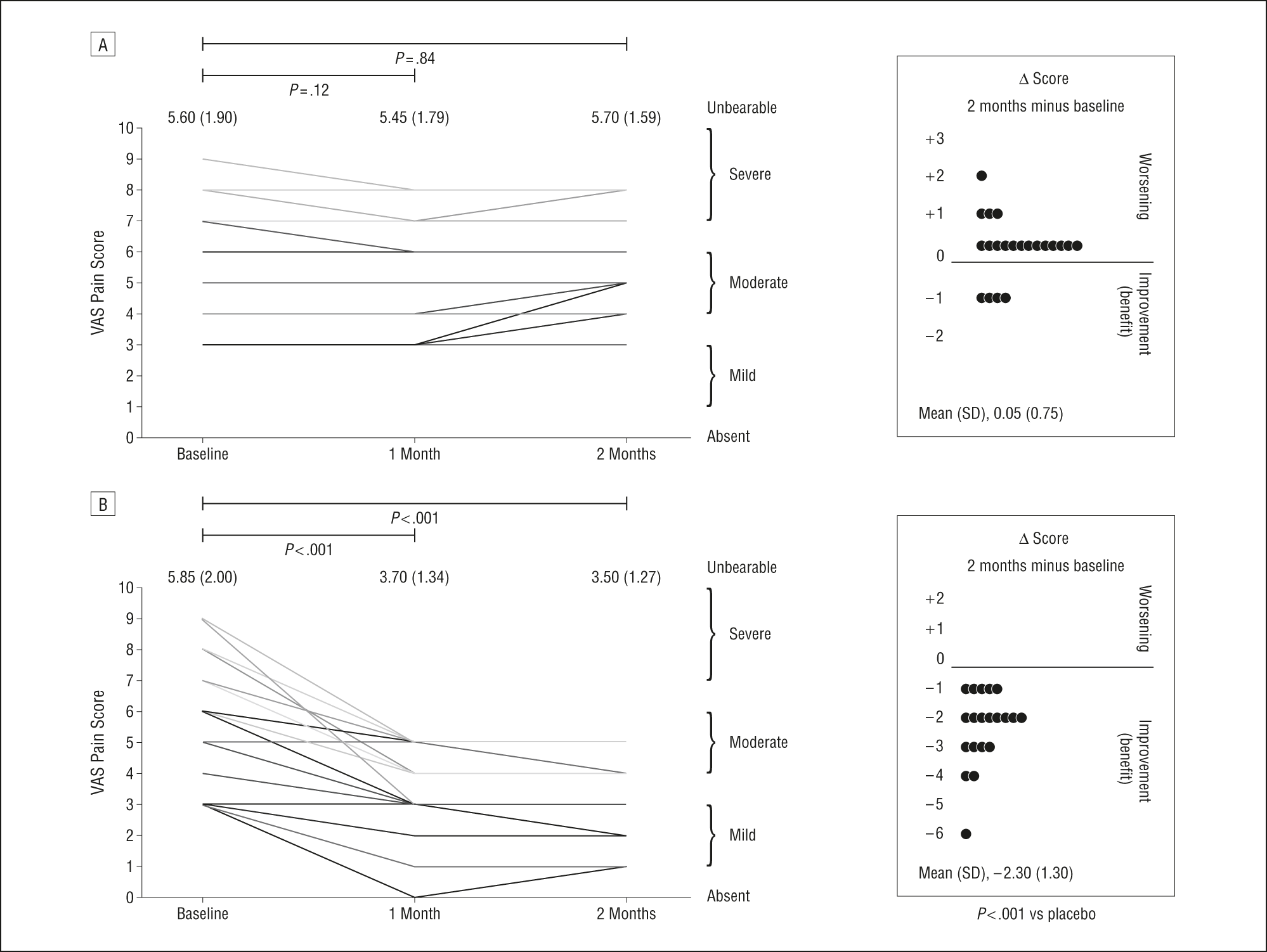
Notice in the graph above, one woman going from a pain score of 9 to 3. Not a full cure, but quite a change!
Not drinking caffeine: Well... Kinda. The woman in this case only got menstrual pain when drinking caffeine.
Raspberry leaves: “early this month before my period i was drinking a tea that was blend with green tea, raspberry, hisbiscus. Well my 1st day of period i always have cramps except this last period no cramps.”
Individualised homeopathic treatment: 21% were fully cured after 2 years.
We just don’t know all the details. How severe was the pain? Was it PD or (undiagnosed) endometriosis or a third condition? How much stress and trauma is there in the history? How much is placebo? What if you stack these different interventions — would they work synergistically?
My Hot Take® is that if we made self-run — but registered — N-of-1 trials easily available, we would start to get some very interesting data. If we run many, I’m sure AI could find the patterns, and we can start developing protocols that are tailored to the individual.
Imagine an app that guides you through collecting data beforehand: Health history, blood test results, pain measured across some cycles, use of painkillers, data from Natural Cycles or other wearables. And then you register the treatment you personally have an interest in or a hunch about. You register the timing of the treatment, dosage, brand (if commercially available)… and all other possibly relevant circumstances. And then the app follows you for another two or three cycles. You end the treatment, and it keeps following you for yet some cycles. Maybe it has a wild ride feature, because you decided to enter a monastery for three months (yes, personal story, that’s for another time), and that was what did it for you. But it’s all recorded.
Knowing that the data is recorded and used for research is a good motivator for keeping up with entering data. And if you drop out, that is also data. If it didn’t work, and you try something else, and that worked — that’s super-duper interesting data!
The most interesting data is the data where the recovery is categorical — pain goes from high to negligible. Menstrual pain varies from cycle to cycle for most women, but for those who have persistently high levels of pain, several cycles without pain would be a big ass deal, and statistically not a random fluke (sudden remission from a chronic disease is very rare). And catching and reporting those cases will give us the real direction for digging deeper.
Ok ok, can we build this N-of-1 app?
It sounds so easy and promising, but this would be A LOT of work. Funding, coding, GDPR, ethics reviews, changing the paradigm. It’s a proper startup.
My approach would be some kind of action research — prototyping, testing, building up a community that feels the vibe, exploring further, applying for grants… maybe publishing. Publishing is tricky: The online network Quantified Self4 has made a white paper on what they call Participant-Led Research (N-of-1 trial where the patient is also the researcher), and concludes that:
…Publishing this work was a non-trivial process. Despite our early intention to not interact with the IRB/REB [the ethical-review boards] process, publication required obtaining an IRB/REB exemption. Even preprint servers require proof of ethical review. How can future Participant-Led Research projects taking place outside academic institutions share generalizable findings when there is no free access to ethical review?
So the roadblocks are real. But no oppressive system has ever fallen without resistance. The resistance is also real. I like this initiative:

And maybe, if the stars align, we will birth some kind of initiative that allows for bottom-up research5, pushes mainstream academia out of their comfort zone, challenges Big Pharma, and brings health to more people across the world!
Let me know if you are interested in a project down this alley, this can only happen through the hard work of many people, sprinkled with a few miracles.
Postscript:
While writing this article, I was wondering if menstrual pain becoming a thing of the past is really possible, and whether we are in an evolutionary dead end, not making babies before we are in our 30s. I talked to Claude about menstrual pain in primates. So, random facts, at your service: Wild female baboons spend most of their adult lives either pregnant or lactating or menopausal, with relatively few lifetime menstrual cycles (somewhat like natural fertility populations of humans). Captive females in well-fed colonies cycle continuously like modern human women, and their endometriosis rates rise correspondingly. It might also be the stress of being around humans. Mood.
I’m going to use a less inclusive language from here, because most, if not all, research has been done on cis-women. Sorry friends, bear with me!
Actually NSAIDs also have a non-normally distributed effect curve: 18% of women with PD are non-responders.
Anecdotes I collected from social media.
A rather male-dominated community: I counted 60 men and 32 women reporting on their experiments across the first 92 blogposts.

Love this! Such a great topic for structured self-research!