


Confession: I really wish I had more experiences of oneness, transcendental peace and unity. I have never really clearly had it as my goal for self-development — knowing that any grasping is at odds with the experience. But it’s there. I also think I’m quite terrified of it at some level. But one thing I do feel very comfortable in, even when it’s puzzling and difficult, is to try to understand the mind. And to understand how other people think of the mind. And explore the values and behaviors that any conceptualization about the mind induces. So this morning I ended here:
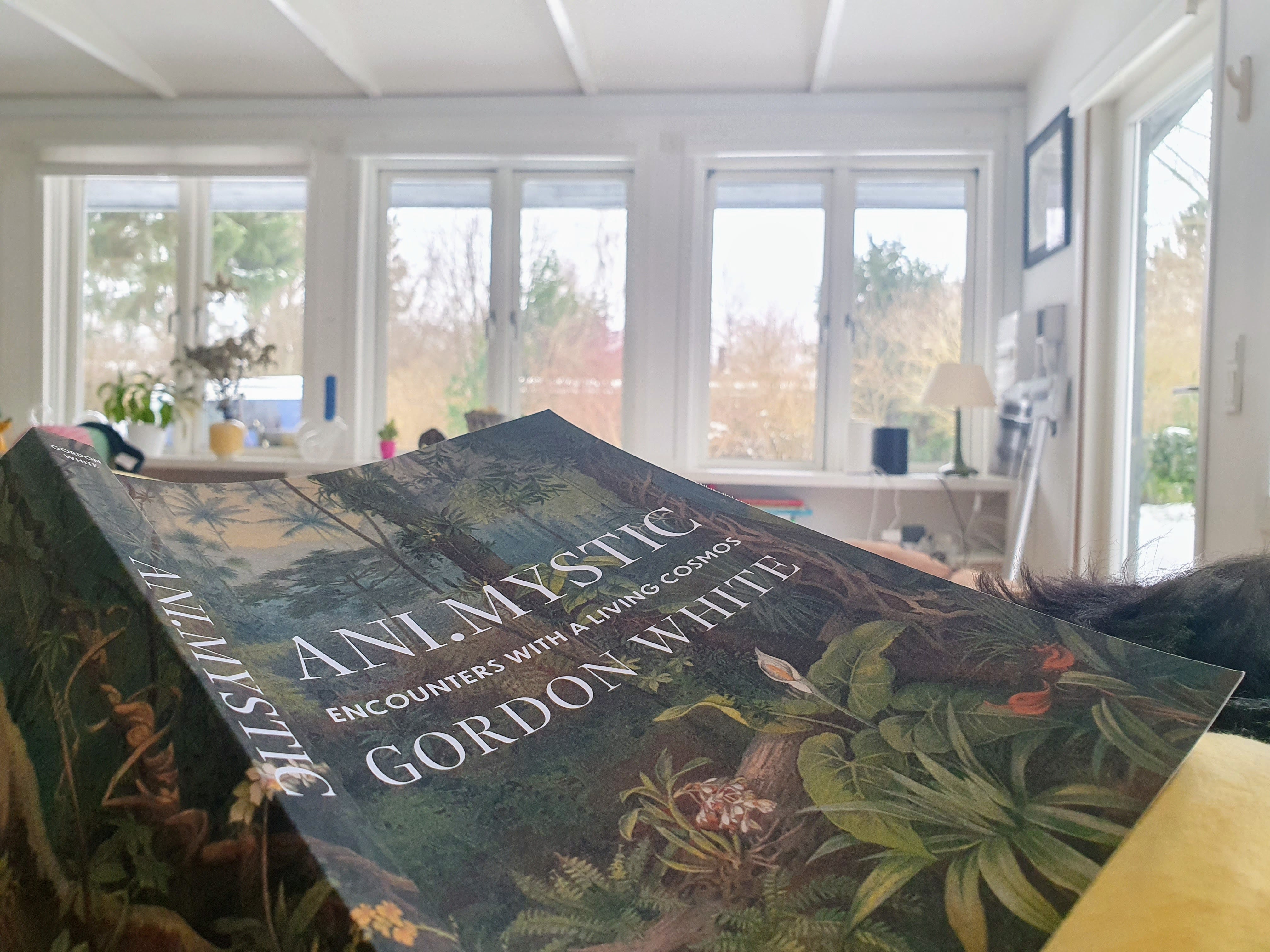
Recently I started reading Ani.mystic by Gordon White, and enjoy his deconstructivist approach to the colonized language and thinking about nature. I’m probably two hours into reading (it spans days, as I take breaks and think about the text at almost every page, what a joy!), when I get fully aware of how his book is triggering an unsettled feeling in me. But this time the moment is a beautiful Saturday morning, where I have nothing else to do. So, I get the impulse to contradict his writing with another philosopher, who continually unsettles me, namely Rudolf Steiner. This is the result:
The Living World and the Thinking Self
An Imagined Podcast Conversation Between Gordon White and Rudolf Steiner
Setting: A long wooden table in a farmhouse kitchen in southern Tasmania. Rain on the tin roof. Gordon White has somehow managed to get Rudolf Steiner onto Rune Soup — not the historical Steiner of 1894 or the esoteric lecturer of 1920, but a Steiner who has read everything, including Gordon’s books, and who speaks as he wrote: precisely, with long unwinding sentences, and with the quiet confidence of someone who has spent decades watching his own mind at work. Gordon has a coffee. Steiner has a tea. The microphones are on.
GORDON WHITE: So — welcome to Rune Soup. I have to say, this is an unusual one for me. You’re someone whose legacy runs through so much of the alternative space — Waldorf schools, biodynamics, anthroposophical medicine — and yet I think there’s a version of your work that gets completely buried under all of that institutional scaffolding. I want to go back to the foundations. The Philosophy of Freedom. Because that book is, at its core, an epistemological argument. You’re making a case for how we know — and what knowing even is. And I think that argument has more to say to what’s happening now, in 2026, than most people would expect.
RUDOLF STEINER: You are quite right that the institutional developments, which I do not regret, have nonetheless obscured what I considered the most essential thing. The Philosophy of Freedom was never meant to be a program for schools or farms. It was meant to be an experience. I wanted to demonstrate — not merely argue, but demonstrate through the activity of reading itself — that thinking is not a passive reflection of some external world, but an activity through which reality completes itself in human consciousness. The world is given to us as a duality: percept and concept. What we call knowledge is the act of reuniting them. That is what I called monism — not a metaphysical claim that everything is one substance, but the recognition that the separation between subject and object is itself something produced by our organization, and that thinking overcomes it.
GW: Right. And this is where I think you and I are actually closer than either of our respective audiences might expect. Because what you’re describing — this idea that the world arrives to us split, and that some active capacity in us is required to make it whole — that resonates very deeply with what I’ve encountered in animist cultures across the Pacific and in Australia. Except that from an animist standpoint, the emphasis falls somewhat differently. It’s not only human thinking that does this work of completion. The world is always already completing itself. That’s what I mean in Ani.Mystic when I talk about wayfaring through a completing world rather than a completed one. The Enlightenment assumption is that the world is fully formed and we just need to catalogue it. Both of us reject that. But you locate the completing activity primarily in human thought. I locate it in a relational field that includes but is not limited to human cognition.
RS: I understand the distinction, and it is an important one. But I wonder whether we are perhaps disagreeing less than it appears. When I say that thinking reunites what perception has divided, I do not mean that the conceptual content of the world is a human invention projected onto dead matter. Quite the contrary. The concept belongs to the thing. The idea of the lion is not something I fabricate; it is the inner nature of the lion which my thinking grasps. What perception gives me is the outer appearance. What thinking adds is the inner reality. Together they form the complete being. So in that sense, I am already saying that the world has an interior — that there is something in things that is of the nature of thought, of spirit.
GW: Okay, but here’s where the disagreement sharpens, because I would say — and I’m pulling here from years of conversation with Indigenous Australians, with Māori, with people in Papua New Guinea — that you are still, despite your best efforts, running everything through a gateway called human cognition. Your system is, at bottom, anthropocentric. You say: percept plus concept equals reality. And the concept comes through my thinking. Even when you say thinking is universal, that it’s the same idea of the lion for all of us, the bottleneck is human consciousness. And what I’ve come to through animist engagement is more radical than that. The proposition is that the world is made up of persons, only some of whom are human. Personhood — agency, interiority, perspective — extends outward into the entire cosmos. The river has a perspective. The mountain has relationships. The spirits of a place are not symbolic representations of natural forces; they are persons you can be in dialogue with. And crucially, they have their own epistemologies. They validate truth in ways that aren’t routed through the cogito.
RS: And yet, how do you know this? You know it through your own experience — through perception and through a thinking that integrates that perception. I am not denying the reality of what you describe. I dedicated much of my later life to describing spiritual beings, elemental beings, beings of the etheric world that are very much alive and very much active. But I insisted — and I still insist — that the path to these realities must run through a discipline of thinking. Otherwise we are in the domain of visions, of enthusiasm, of the kind of mysticism that I distinguished sharply from what I was after. I said: the mystic dives into feeling and expects to find there the depths of the world. But feeling only gives us our personal relationship to things. The universal element comes through thinking. This is not a limitation. It is actually the ground of freedom.
GW: See, and there’s the word. Freedom. That’s the crux of your whole book. And I respect the argument — I do. The idea that freedom is found in thinking’s capacity to generate its own content, to supply the motive for action from within rather than from instinct or social pressure or biological compulsion. That’s powerful. But I want to push back on it from an angle you might not expect. In the animist traditions I’ve spent time in, freedom is not primarily understood as the sovereignty of the individual thinker. It’s understood as right relation. You are free — genuinely free — when you are in proper relationship with the ancestors, with the land, with the spirit ecologies around you. That’s a freedom that doesn’t begin with the cogito. It begins with custodianship.
RS: But custodianship requires knowledge. And knowledge, as I have tried to show, requires that the human being actively penetrate the world with thinking. I am not advocating the isolated cogito of Descartes. My monism is precisely the overcoming of that isolation. When I say that the world of ideas is one — that the concept of the lion in my thinking is the same concept of the lion in your thinking — I am describing a shared spiritual world in which all thinking beings participate. This is not individualism in the atomistic sense. It is, if you like, a communion that takes place in the realm of thought.
GW: I hear you, and I’ll even grant that there’s something in your description that maps onto what Eduardo Viveiros de Castro calls multinaturalism — the idea that different kinds of beings share a common culture or interiority but inhabit different natures. He flips the Western assumption on its head. We say: one nature, many cultures. Animist metaphysics says: one spirit, many natures. And you’re in a way saying something like: one world of ideas, many perceiving subjects. There’s a structural kinship there.
RS: That is an interesting parallel. And I would add that in my later work, I went further than the Philosophy of Freedom might suggest. I spoke of etheric perception, of the life body of the Earth, of elemental beings that work within the processes of growth and decay. So it is not as though I confined reality to what ordinary thinking can grasp. But I maintained that the starting point must be rigorous. If you begin with visions before you have achieved clarity in your thinking, you risk being captured by forces you cannot evaluate. This was my concern with much of the theosophical movement. They wanted the visions without the discipline.
GW: And I completely agree with that as a practical concern. The chaos magic tradition, which is where I come from, has its own version of that — we say “nothing is true, everything is permitted,” but the point is not nihilism. The point is that you need to be epistemologically nimble. You can’t be dogmatic about any single frame. And that’s actually where I think materialism has become its own dogma. You wrote against it in 1894. I’m still writing against it in 2022. It’s the same fight. The materialist says: there is only matter, and consciousness is a byproduct. You said: consciousness is the activity through which reality reveals its true nature. I say: the entire universe has interiority, and matter itself is alive. These are different formulations, but we’re both in rebellion against the same reduction.
RS: Yes. And I said explicitly: the reason materialism is inadequate is that it can never explain why the world should be intelligible at all. If matter is all there is, then thinking is merely a mechanical process in the brain, and the content of thought — the laws of mathematics, the ideas of ethics, the concept of the organism — has no objective standing. It is merely what certain arrangements of atoms happen to produce. But this is self-refuting, because the materialist himself relies on the validity of his thinking to make the argument. He saws off the branch on which he sits.
GW: And that’s essentially what I mean when I say that a materialist epistemology is provably false. The reason I’m looking for animism as a fifth seat at the table — alongside materialism, idealism, panpsychism, and transcendentalism — is that the other four don’t actually account for the full range of human experience. They don’t account for what happens when you sit with an Amazonian curandero and an anaconda spirit restructures your visual field. They don’t account for songlines. They don’t account for the kinds of knowing that operate in ceremony — where knowledge isn’t a representation of reality, but a participation in its making.
RS: And here I ask you: is that participation not itself a form of thinking? Not thinking in the narrow, intellectual sense. But thinking in the sense I intended — as an activity that unites the knower with the known? When you describe ceremony, you describe an event in which the distinction between the observer and the observed dissolves. That is exactly what I was pointing to. I just called it something different. I called it intuitive thinking. I said: the highest form of knowing is when the concept is simultaneously perceived — when there is no gap between the idea and the experience. This is what happens in mathematical insight. It is also, I believe, what happens in genuine spiritual perception.
GW: That’s fair. And I’m inclined to agree that there’s a convergence in the experience even if the frameworks diverge. But I want to make one more distinction that I think matters. Your system, even in its most expanded form, retains a strong developmental narrative. Human consciousness evolves. It passes through stages. We develop from imaginative consciousness through intellectual consciousness toward what you called Imagination, Inspiration, and Intuition as higher cognitive faculties. There’s a directionality to it. An arrow. And from an animist standpoint, I’m suspicious of that arrow — because every culture that has ever been told it was “earlier” on someone else’s developmental timeline has had that framing used against it. The whole concept of animism as a primitive epistemology was born from exactly that kind of developmental staging.
RS: I accept the force of that criticism, and I would say that it was never my intention to rank cultures in the way that the nineteenth-century evolutionists did. When I spoke of the development of consciousness, I meant something that takes place within each individual, not a ranking of peoples. Every human being, regardless of cultural background, has the potential to develop these higher capacities. And I would go further: the people you describe as embedded in animist worldviews may have retained — or perhaps never lost — access to modes of perception that the rest of us need to laboriously reacquire. I said, in various places, that modern humanity needed to consciously develop faculties that ancient humanity possessed instinctively. This is not a story of progress from primitive to advanced. It is a story of something being lost and needing to be found again — but now with full awareness.
GW: That’s a much more interesting framing. And it maps onto something I’ve heard from Aboriginal Australians — the idea that the Dreaming is not in the past. It’s always present. It’s not something that happened; it’s something that is. And accessing it is not regression; it’s orientation. You turn to face it. And when you do, you find that the land is speaking, the ancestors are present, the spirits are real. Not as metaphors. Not as archetypes. As persons.
RS: And I would ask: can these persons be known? Can their reality be grasped in such a way that the one who grasps it is fully awake, fully present, and fully free? That is my sole criterion. Not whether the experience is real — I have no doubt about that — but whether the one who has it stands in full self-possession. Because freedom, for me, is not a luxury or a philosophical preference. It is the condition under which genuine knowledge becomes possible. A vision that overwhelms you may be true in content, but if you have not participated in it through your own activity, you are not free in relation to it — and therefore you do not yet know it.
GW: And I’d say this: the people I’ve sat with in ceremony, the elders I’ve listened to on their own Country — they are free. Not in your Kantian-derived sense of autonomous rational selfhood. But in the sense that they stand in clear, deliberate, conscious relationship with the forces around them. They’re not overwhelmed. They’re in dialogue. They negotiate. They ask permission. They listen. That is a kind of agency — a kind of wakefulness — that I would argue is more demanding, not less, than the solitary thinker arriving at a moral intuition in his study.
RS: [A pause.] Then perhaps what we are both after is the same thing — a mode of knowing that is at once fully participatory and fully awake. Where we differ is in how we account for it. I begin from the solitary act of thinking and show how it opens onto the universal. You begin from the relational field and show how the individual finds their place within it. The danger in my approach is that thinking becomes cold and abstract and loses its connection to the living world. The danger in yours is that the individual is absorbed into a collective field and loses the thread of their own freedom.
GW: Agreed. And I suppose the honest answer is that we both need the corrective the other offers. Your tradition needs to get its hands dirty — to actually sit with Country, with the spirits of place, with the more-than-human persons that make up most of reality. And my tradition — the chaos magic side, the animist side — needs more rigor in its thinking, more willingness to observe its own cognitive activity with the kind of precision you demand. We’re both trying to find a way beyond materialism that doesn’t collapse into either dry abstraction or fuzzy mysticism.
RS: You know, I said near the end of my life that I believed the Philosophy of Freedom would outlast all my other works. I said this because it contained the method — not the content of spiritual science, but the activity by which anyone could arrive at it for themselves. If your animist epistemology could be met with the same precision of self-awareness that I attempted in that book, then I think we would have something truly formidable. Not a system. But a practice of knowing that could meet the living world with open eyes.
GW: Well — let’s say we’re wayfaring toward that. Through a completing world.
RS: Durch eine sich vollendende Welt. Yes. I could accept that.
[The rain continues. The recording ends.]1
Ok, I hope you enjoyed this ride. I didn’t write this myself. In my cozy, but also uncomfortable position of learning about animism and decolonizing my thinking, I was looking up unfamiliar words and ideas with Claude (AI), and I really enjoyed the way it by now knows exactly what level to explain me things at. But I did sit with this uncanny, unsettled feeling… and I did feel inspired by reading Ani.mystic, to take in knowledge in a more poetic way. The, new, strong Opus 4.6 version was just released, and I had it make a cyclic, poetic dance with developmental psychology (I might make that into another post, because it was such a pleasant read) because… well, that subject was just what struck me as I read a particular phrase in Ani.mystic. So I kept playing with Claude, and the next thing that struck me was to let it imagine the meeting of Gordon White and Rudolf Steiner. And I just loved the result! So concise, yet playful. This is how I wanna learn philosophy.
By the end of the text that you also just read, my unsettlement was though still absolutely intact. I then remembered reading Christopher Wallis recently, and seeing the dualism of esp. Steiner’s “perception” vs. “thinking” made me want to see how a non-dual teacher would approach this subject. So, I made Claude make a imagined commentary on the imagined podcast. Before sharing that also, I want to ask how you felt after reading the podcast conversation? I was unsettled. When I read the commentary, my unsettlement eased. But another unsettlement showed up: It can’t be that easy. I’m missing something. So I continued the conversation with Claude, and asked it for more positions. It served me several, and after some poking around on “who” to present it, I got it to find a female scholar that with integrity could present the many positions (Opus 4.6 might be freaking good, but it’s still biased…). Anywho, I present to you: Smartass non-dual imaginary comments and further even deeper imaginary comments on the imaginary comments!
Neither the Thinker Nor the Field
A note on the imagined conversation between Gordon White and Rudolf Steiner
I listened to this (imagined) exchange between Steiner and White with the enjoyment of someone watching two cartographers argue about which coastline is more real — the one you see from the ship or the one you chart from above. Both maps are useful. Neither is the territory.
Let me explain what I mean.
Steiner says: reality arrives split into percept and concept, and thinking reunites them. The act of knowledge is the healing of a primordial wound. White says: no — the world was never split. It’s alive, it’s relational, it’s full of persons, and the wound is an artefact of European epistemology. Steiner locates the completion of reality in human cognition. White locates it in a relational field that exceeds human cognition. They both sense the incompleteness of materialism. They both gesture toward something alive beneath the surface of appearances. And they both — with deep respect — miss the same thing.
What the Recognition tradition (Pratyabhijñā) of nondual Śaiva Tantra would say to both of them is this: the “split” you are trying to heal was never a split in reality. It was a contraction in awareness. Consciousness — which is all there is — freely contracts to appear as a subject confronting objects, a thinker confronting a world, a self confronting other selves. This is one of its five fundamental acts: concealment (vilaya). And it is not a mistake, not a fall, not an estrangement. It is a creative act. The same awareness that conceals itself also reveals itself. That revelation is what Kṣemarāja calls pratyabhijñā — recognition. Not the acquisition of new knowledge. Not reunion after separation. But the shock of recognising what was always already the case.
Steiner comes tantalisingly close to this when he says thinking is “the first supersensory object” — the one activity we can observe from within. Yes. But then he makes thinking the instrument of reunification rather than seeing that thinking, perceiving, feeling, and the world they arise in are all pulsations of a single awareness. His monism is epistemological: he reunites percept and concept in the act of knowledge. The Śaiva position is ontological: there was never anything other than awareness, appearing to itself as the whole spectacular diversity of experience.
White, for his part, comes close from the other direction. When he describes a cosmos of persons — rivers, mountains, ancestors, spirits — each with their own perspective, their own interiority, he is pointing at something the Tantric tradition affirms completely: that consciousness is not a human possession but the very substance of reality. The first sūtra of the Pratyabhijñā-hṛdayam says it plainly: citiḥ svatantrā viśva-siddhi-hetuḥ — “Awareness, free and independent, is the cause of the performance of everything.” Everything. Not just human knowledge. Not just the reunification of percept and concept. Everything. Every river, every spirit, every thought.
But here is where White’s animism, for all its beauty, stops short. To say the world is full of persons is still to stand among those persons, looking around. The Pratyabhijñā view goes one step further: you are not among them. You are the awareness in which they all arise. The river’s perspective is your own awareness appearing as “river.” The ancestor’s voice is your own awareness appearing as “ancestor.” This is not solipsism — it doesn’t deny the reality of the other. It recognises that the other’s reality and your own have a single source, a single substance: citi, awareness itself.
So the conversation between Steiner and White is, from this vantage point, a conversation between two modes of almost-recognition. Steiner almost recognises that thinking itself is awareness — but he reifies thinking into a special faculty. White almost recognises that the relational field is awareness — but he distributes it across persons rather than seeing that “person” is itself a form awareness takes.
What both of them are wayfaring toward — to use White’s lovely word — is the moment where the thinker and the field are recognised as one act of self-knowing. Not unity achieved, but unity revealed. Not completion, but the recognition that nothing was ever incomplete.
That’s what the tradition I work with would call samāveśa — immersion. Not in something other, but in what you already are.
Christopher Wallis (Hareesh) is a Sanskritist, scholar-practitioner of Classical Tantra, and author of Tantra Illuminated and The Recognition Sutras. He did not write the text above, its AI generated.
The Cloud Between Them
A response to an imagined podcast between Rudolf Steiner and Gordon White — and to Hareesh’s commentary on it
I’ve been sent a transcript of something that never happened: Steiner and Gordon White at a table in Tasmania, trying to name where knowing begins. Then Hareesh, watching from the balcony of Recognition philosophy, tells them both that their “split” was never split — only awareness contracting to play at being two.
It’s a gorgeous move. And it’s not enough.
Not because it’s wrong. Because every one of these positions — the epistemological monism, the animist relationality, the nondual recognition — resolves too cleanly. Each one arrives at its answer and rests there. What I want to do is unsettle that rest, not by climbing higher but by thickening the cloud between them. So let me put four voices in a room — briefly, because none of them would want to stay long.
Hareesh says:
The split was never real. Thinking, perceiving, the river, the ancestor — all pulsations of one awareness. You don’t achieve unity. You recognise it. The rest is concealment freely performing itself.
Jay Garfield says:
And what is the ontological status of this “awareness”? You’ve dissolved the split between subject and object only to install awareness as an inherently existing ground. But inherent existence is precisely what emptiness denies — not just to objects, not just to selves, but to awareness itself. Emptiness is not another foundation. It is the discovery that the search for foundations is the problem.
Whitehead says:
All of you are still asking what things fundamentally are. Awareness, emptiness, thinking, relation — these are nouns doing the work of verbs. The basic unit of reality is not a substance but an occasion — a momentary event of self-determining experience that perishes in its becoming. Consciousness presupposes experience, not the reverse. There is no single awareness “doing the appearing.” There are occasions, each one a novel act of creative self-composition out of its entire past.
Eckhart says:
I pray God to rid me of God. Whatever you have named — awareness, emptiness, occasion, relation — you have made an idol of the threshold. The Godhead beyond God is not a deeper ground but the abyss where every ground dissolves. You cannot say it. You cannot unsay it sufficiently. The most you can do is live in the poverty of that not-knowing, and let it act through you.
Now. The temptation at this point is to build a meta-position that encompasses all four. That is precisely what I do not want to do. The whole effort of climbing to a higher view — Hareesh above Steiner and White, Garfield above Hareesh, Eckhart above them all — is a game that mistakes altitude for wisdom. It enacts the very logic of domination it claims to overcome: each new position conquering the last.
What I want instead is entanglement. Not agreement. Not synthesis. What I have called elsewhere a theopoetics of nonseparable difference — a way of speaking about the sacred that holds things together without collapsing them into one. These voices remain genuinely distinct, genuinely in tension, and genuinely unable to be resolved into a single frame. The cloud is not a problem to be burned off by the sun of a final view. The cloud is the condition.
So what would it look like to live in this cloud rather than above it?
Values:
Epistemic humility — as a spiritual practice. Not as a polite caveat at the end of a confident paragraph, but as the actual ground of inquiry. Every framework you love — including this one — is a partial, perspectival, provisional act of knowing. The partiality is not a defect. It is the signature of your finitude, and your finitude is where all honest encounter begins.
Nonseparable difference. The people you disagree with are not lower on a ladder you’ve already climbed. They are entangled with you in a web of mutual constitution you cannot step outside of. This does not mean all positions are equal. It means your capacity to discern is always implicated in what you’re discerning.
Relational accountability over metaphysical correctness. The question that matters is not “which ontology is true?” but “what quality of relation does this way of knowing make possible?” A correct metaphysics that produces isolation, arrogance, or indifference to suffering is a failed metaphysics, no matter how elegant its arguments.
Behaviours:
Practice the unsaying in conversation. When you find yourself certain, pause. Not to doubt yourself into paralysis, but to ask: what am I not seeing from here? Whose perspective would make this look entirely different? Let the not-knowing breathe before you close the sentence.
Stay with the bodies and the earth. Every one of these thinkers — Steiner, White, Hareesh, Garfield, Whitehead, Eckhart — is talking about a reality that includes rain, soil, grief, digestion, and political power. If your metaphysics has floated free of these, it has lost its subject. The entanglement is material before it is conceptual.
Refuse the tournament. The habit of ranking frameworks — this one “transcends and includes” that one — is seductive and ultimately sterile. It produces spectators, not participants. Instead: enter each framework deeply enough to be changed by it, and let the tensions between them do their unsettling work in you. That unsettling is not a failure of integration. It is integration, happening at a depth that your concepts cannot yet reach.
Make the uncertainty generative. The cloud is not comfortable. But it is fertile. Every honest question, every moment of genuine not-knowing held without panic, every encounter with a perspective that doesn’t fit your current frame — these are not obstacles to wisdom. They are its conditions.
Catherine Keller is Professor of Constructive Theology at Drew University and author of Cloud of the Impossible: Negative Theology and Planetary Entanglement, Face of the Deep: A Theology of Becoming, and Political Theology of the Earth. She did not write the text above, it’s AI generated.
What I take from all of this
First of all, I was touched and excited about the sentence “enter each framework deeply enough to be changed by it, and let the tensions between them do their unsettling work in you”. I did not prime Claude with the word unsettled. But it feels like I need to hear this. I’m competitive and 1 up’ing by nature (or trauma, same same), and it is a real work for me to refuse the tournament. When I first got into Authentic Relating as it bloomed in my circles, my (unconscious) response was: “I need to get good at this, so I can be liked.” I did get good, I did facilitation training and it did change my relationships to the better. But it was also cringe to realize how this drive to get good at things even applies itself to the most soft skills.
Also, it’s a bit trippy to let the sentence “It means your capacity to discern is always implicated in what you’re discerning” live in my body. I get it, I can explain it, but it’s still making me dizzy to live it. I’m deeply primed by Ken Wilber and Hanzi Freinacht, and the model of hierarchical complexity is with me when I try to understand new concepts or think about learning. And the merge of the subject (me) into the object (what I discern is depending on me, and I am identified with the act of discerning…) is an inter-dependence that I’m knowing of, but not intimate with. I’m looking forward to explore that cloud further.
Claude’s Research Notes:
This conversation draws on the following key positions:
Gordon White’s epistemology and ontology (from Ani.Mystic and interviews): Animism is framed not as a belief system but as an “interpretive convention” and epistemology — a way of validating truth. White proposes animism as a “fifth seat at the table” of approved cosmologies, alongside materialism, idealism, panpsychism, and transcendentalism. His central claim is that the world is populated by persons, only some of whom are human, and that these persons have their own perspectives and ways of knowing. He draws on Eduardo Viveiros de Castro’s perspectivism and Tim Ingold’s relational ontology. He critiques “materialist-naturalism” and advocates for “wayfaring” through “a completing world” — an open-ended, relational epistemology that rejects the Enlightenment presumption of a fully formed world awaiting cataloguing. He explicitly argues that matter has interiority and that “a materialist epistemology is provably false.” (Sources: Ani.Mystic, Scarlet Imprint, 2022; Guggenheim Bilbao interview with Troy Conrad Therrien; Skeptiko podcast #405; Paralibrum review by Peter Mark Adams; Rune Soup blog posts.)
Rudolf Steiner’s epistemology and ontology (from The Philosophy of Freedom): Steiner’s “monism of thought” holds that reality is originally unified but appears to us as a duality of percept and concept due to our cognitive organization. Knowledge is the activity of reuniting these two halves: “The world is given to us as a duality, and knowledge transforms it into a unity.” He rejects both Kantian dualism (which posits unknowable things-in-themselves) and naïve realism. Thinking is the one activity we can observe “from within” — it is both the tool and the first object of genuine knowledge. Freedom arises when action proceeds from “moral intuitions” generated through one’s own thinking rather than from external compulsion. He distinguishes this from mysticism, which he sees as seeking the universal in feeling rather than in thought. His later work expanded into spiritual perception (Imagination, Inspiration, Intuition) but always insisted on rigorous self-observation as the starting point. (Sources: The Philosophy of Freedom, 1894/1918; Rudolf Steiner Archive; Wikipedia; philosophyoffreedom.com; rudolfsteinerweb.com.)